
Relocatable Tiny Houses: What Happened at the Code Hearings, and What Comes Next
My last update asked for your help getting relocatable tiny houses recognized in the International Residential Code. So many of you signed the petition, shared the proposal, contributed toward travel, and helped us get to the public comment hearings in Hartford in April.
It’s long overdue, but you deserve an update.
Sadly, the proposal was not approved.
I cannot speak for the others, but it took me a while to collect myself after that last hearing. I had poured so much of myself into the whole thing. I was crushed because this is personal for me.
I’m grateful for Martin, who pulled me back into the hearing room the following day to talk with some of the people who had spoken against us. Those conversations were productive. We were able to address some common misconceptions, and they offered useful feedback on how to move forward despite the setback.
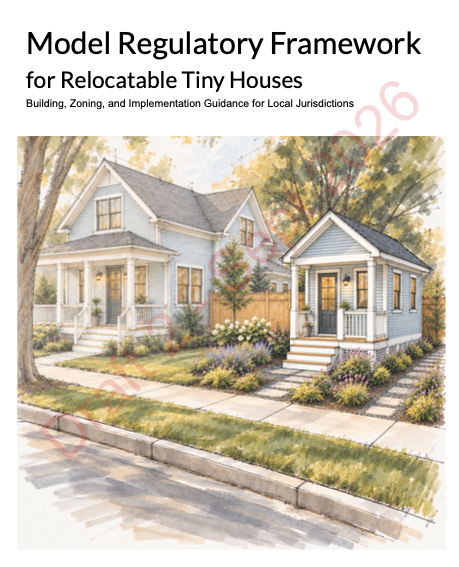
I wasn’t sure I would find the energy for it – I was pretty sure I wouldn’t if I am being honest – but since the hearings, I’ve been working with members of our proposal team on a Model Regulatory Framework for Relocatable Tiny Houses. It is a resource to help interested communities address building standards, zoning, inspections, and the practical questions involved in permitting these structures as homes.
This approach involves considerably more legwork. A national model-code provision would give communities a shared starting point, even though adoption would still happen at the state or local level. Working community by community means more individual conversations. But another code cycle takes years. In the meantime, we can make this information available to jurisdictions that are ready to move forward now. And if there is one thing we have going for us, it’s a nationwide community of people who can help have those conversations.
Here’s how we got here.
What happened in Hartford?
Our proposal, RB42-25, sought to add provisions for relocatable tiny houses to the IRC’s existing tiny house appendix, Appendix BB. The goal was to establish a residential code pathway for small homes built on a chassis and placed on a site for residential use as a dwelling.
Getting there involved multiple rounds of hearings, revisions, technical work, and public comments. At the final public comment hearing in Hartford, we first had to overcome the earlier committee action to get our proposed changes considered on the floor.
We cleared that hurdle by the skin of our teeth. We presented our case. Ultimately, though, we did not get the approval needed to move the proposal forward.
That was disappointing because this pathway is so needed, and a lot of people put substantial time, expertise, money, and heart into the effort. I remain grateful for the team that showed up and made the case. They did so well, and everyone who helped us get there made that participation possible.
What was the disagreement?
Some of the discussion concerned how these homes would be inspected and whether too much liability would be placed on building officials regarding transportation. Those are important questions, and they deserve clear answers. A substantial part of the debate centered on whether a home that can be relocated belongs within the residential code at all, and whether our proposal fit within the ICC’s procedural requirements.
From my perspective, those questions overshadowed the practical problems we were trying to solve. It was frustrating to spend so much of our limited time debating whether the proposal even belonged in the process rather than how communities could safely permit these homes.
The reality is that people already live in these homes. Communities already receive applications for them. Building officials already have to decide what to do when someone moves one into their community.
Our position was that a tiny house designed, constructed, and used for residential occupancy should have a clear way to demonstrate that it meets residential safety requirements. Its ability to be moved does not eliminate the need for safe stairs, adequate emergency access and egress, structural stability, sanitation, or any of the other protections we expect from other homes.
It does introduce additional questions about the chassis, connections, and transfer of structural loads. Those were precisely the gaps we were trying to address.
The hearings also reinforced how demanding this process is for a grassroots effort. Participating requires technical expertise, familiarity with procedural rules, time away from work and family, and the resources to keep showing up. I’m proud that our team brought the experiences of people who build and live in these homes into that room. It took so much grit. From donors and petition signers to the folks who stood up to testify, this community made that participation possible.
What does the outcome mean?
We did not achieve the model-code change we sought this cycle. The uncertainty that prompted the proposal remains, along with misconceptions and skepticism about this housing type.
For someone hoping to build or place a relocatable tiny house, the available approval process still depends heavily on the jurisdiction and whether it has established a workable pathway at all. And it means people are going to necessarily keep flying under the radar in order to make their best housing choices.
It also leaves the immediate question: What can communities do to address these homes now?
Following the hearings, several people, including some who spoke against us, encouraged us to assemble an informational packet and develop something jurisdictions could use right now when considering these homes.
In the room, I laughed at that idea. This process had consumed well over a year of my life. I am not exaggerating when I say I had worked on it like a full-time job, every day. Honestly, taking on another substantial project sounded impossibly exhausting after everything we had just put into the hearings.
I don’t know what else to do, though. I feel it in my bones that tiny houses are an important part of addressing our housing challenges. I have 15 years of lived experience, and I have reaped more than my fair share of benefits by choosing to live this way. This lifestyle should be a genuine option for others. And it shouldn’t take nine years of negotiating with jurisdictions, while living with the possibility that you could be forced to leave your community at any time, just to feel secure. That was my experience. It shouldn’t have to be someone else’s.
We had already developed technical material, worked through objections, and identified questions that kept coming up. That work can still become a useful starting point for the communities facing the same questions.
What we’ve been working on since
Shortly after we got home from the hearing, I started putting together the Model Regulatory Framework for Relocatable Tiny Houses.
The packet is intended for interested jurisdictions and for individuals seeking a legal pathway for tiny house living who want something concrete to bring to their community leaders.
It is now in its second draft and is being circulated for broader technical review. It brings together four pieces:
- Background and explanation: What relocatable tiny houses are, why people choose them, how people use them, and why their relationship to land and ownership matters.
- Model building code language: Proposed provisions addressing the chassis, structural connections, site support and anchorage, and approval pathways for new and existing homes.
- Model zoning ordinances: A starting point for deciding where these homes may be allowed and how they can fit into local residential zones.
- Implementation guidance: Practical considerations for permits, inspections, documentation, utilities, departmental coordination, and occupancy approval.
The intent is to give interested jurisdictions a useful foundation they can evaluate, adopt, or adapt within their legal authority, existing regulations, and local conditions. Each community should not have to start with a blank page.
Keeping the pathway accessible
Throughout this work, my focus remains on the people who want to live in these homes, particularly people like me who want to build their own.
A residential approval pathway should accommodate owner-builders, small local builders, and community, educational and non-profit efforts alongside manufactured options. For many of us, the opportunity to contribute our own labor is what makes this housing attainable. Any framework developed for tiny houses needs to preserve that opportunity.
There is real power in people being able to take an active role in creating their own housing and improving their own circumstances. That deserves a place in the regulations we write.
A useful framework needs ways for these different approaches to demonstrate compliance and give local officials the tools to evaluate them. Clear requirements and understandable inspections matter, especially for people who do not have a regulatory consultant guiding them through the process.
How you can help now
The immediate need has shifted from support for a hearing vote to thoughtful review and connections with communities who are interested in creating workable pathways.
If you are:
- A building official or planner who encounters tiny house applications;
- Part of a housing organization exploring additional housing options;
- An engineer, builder, or other technical professional who can help review the approach; or
- A resident working with local officials who are interested but unsure where to begin;
I’d love to hear from you. Visit relocatabletinyhouses.org for a brief introduction and contact information. Please include your organization or jurisdiction. If you’re a resident advocating for this option, a connection with interested local officials would be especially helpful.
The framework remains a working draft, with some technical provisions still under development. We’re seeking focused feedback to help make it useful and workable for the communities that may use it.
This housing movement is driven by people. We’re persistent. We know from experience what these homes can make possible. So, on we go. We’ll find a way.
And to everyone who signed, donated, shared, testified, or encouraged us: thank you. Your support helped us participate in a difficult process, and the material and relationships developed through that effort are shaping this next phase.
I wish this were an update, written months ago, announcing that the proposal passed. It isn’t. But we’re still working toward the same outcome: making it possible for more people to build or buy a tiny, safe home with a clear, legal pathway to live in it.
Thank you and your group for all your hard work on this issue. As a tiny home owner of 10+ years, I appreciate your efforts. It’s so disappointing that your year of preparation and advocacy ultimately came to nothing. But it’s good that you can at least take your depth of knowledge and experience and apply it to the development and distribution of this informational packet. Hopefully, that will help communities and tiny home owners who need it.
I am so fortunate to live in Durango, Colorado, where they have welcomed tiny homes. We have 3 dedicated tiny home communities (2 within our city limits and 1 in the outlying rural area), and a number of tiny homes, including ours, that have been allowed in mobile home parks. We embarked on our tiny home journey so naively, not even realizing where to park it would be an issue. Luckily, we decided to settle in Durango, and though we did have to overcome a few early hurdles back in 2016, ultimately, we found our spot in the perfect place for us.
Thanks again, Macy, for all you have done, are doing, and will do. I am not any kind of an activist, but I sure do appreciate those of you who are!
Forgive the ignorance, but isn’t a mobile home… relocatable? And what about stick homes that are plucked off their foundation and moved (albeit not that often and usually historical buildings) – isn’t that “relocation”? It’s not like THOWs are being moved every year unless they’re forced to. The whole point of ownership, for most of us, is to put down roots and establish “home” and community.
Thank you Macy and crew for all you’ve done and continue to do. Thank you! Thank you!