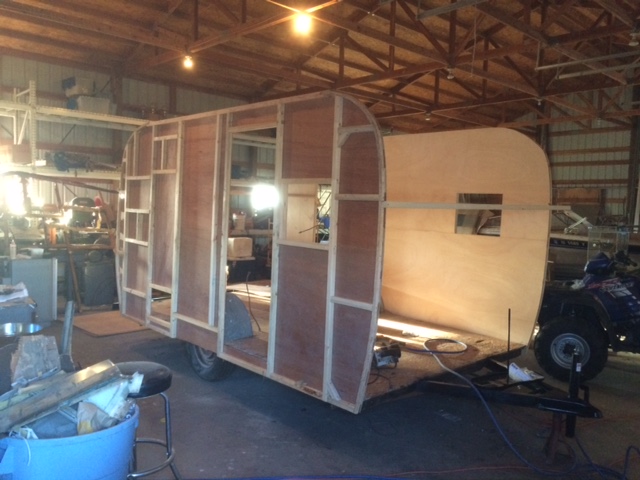
Update 5.5.13

May 5, 2013 § 9 Comments

Here is this days progress.  I started the pallet siding.  Here are some pictures:

About these ads

Update 4.11.13

April 11, 2013 § 6 Comments

It was sorta a lazy night, well as much as I ever have those… mostly because I am SORE!  I’m not sure what exactly I did to strain every muscle in my legs but I feel like I was doing squats for 5 hours yesterday!  I took the opportunity to get a decent jump on my trellis, there is lots more to do but it only took about an hour to get this far so it should be done soon :) .

2013-04-11_19-48-58_514

So, to not feel so bad about not doing a ton of work I took the opportunity to think through my process on how to wrap this project up!

Announcement! I was accepted to be a keynote speaker at Boise’s first ever Mini Makers Faire which is pretty darn exciting! (I will probably be asking for advice on getting together some sort of presentation on this in the near future)  It takes place over Memorial Day weekend so I have decided that would be a good goal to be complete by (May 25th and 26th).  In order to make that happen though I need a game plan, the following is a list of the items left to finish and my estimation of time if applicable:

Trellis (3 hours)

Tile Floor

  • Install heat tape (4 hours)
  • Apply mortar bed (2 hours plus sitting overnight)
  • Install tile (8 hours)

Tile Shower

  • Apply RedGaurd (1 hour plus sitting overnight)
  • Install tile (8 hours)

Millwork

  • Cut cabinet doors (2 hours)
  • Paint cabinets (6 hours)
  • Build drawers (10 hours)
  • Install pulls (2 hours)
  • Bookshelf (3 hours)

Siding

  • De-nail boards (20 hours)
  • Rip boards to size (4 hours)
  • Plane boards (4 hours)
  • Install Siding (16 hours)

Connect Plumbing 

  • Shower
  • Lav
  • Kitchen

Fix the Electrical I messed up (4 hours)

Install Toilet (3 hours)

Replace Tires (trip to the store)

Front Electrical Closet Doors (3 hours)

I have approximately 6 weeks to complete it in the timeframe, 2 and a half of those weekends I will be out of town or unavailable so this will be a tight squeeze and mostly weeknights after work!  It has been getting much easier to work on it now that things are getting all prettied up!  Each checkmark affects the aesthetics, it’s pretty neat for me.

Last night I was able to just sit and relax in the bed area, it equalled a pretty zen moment and an incredible feeling of pride!  That’s it for now!

Macy

I Have an Idea!

April 9, 2013 § 25 Comments

So, I am building on a goose-neck trailer and I drive a Prius… obviously I am going to need help when it comes to moving my house.  Here are a few options I have considered, let me know if you have others!

1) I would rent a UHaul if it was just a standard hitch, but it isn’t.  I have called everywhere to see about renting a truck with a goose-neck hitch, they just aren’t out there.

2) Plan ‘b’ has been to put an ad on Craigslist and find someone willing to move it for me with some sort of compensation OR

3) hire a tow truck, either would work ok but I would be tied on schedule, which is hard for me AND I would be out probably a couple hundred bucks every time I want to move… my next thought was

4) to install a goose-neck on my dad’s or my brothers’ truck which would cost near $800 and be sort of an inconvenience for them…

5) So, I had the idea to cruise over Craigslist, see what the prices were like on a truck that is able to pull it.  Now I don’t mean a brand new truck, I mean an old, reliable type of farm truck, I mean it’s a farm trailer… why not go for the matched pair.  Then the idea is that I can sell the truck back to someone else after it’s moved.  As I got to looking at the trucks I had another idea!

6) One of the biggest issues I have had with downsizing my life is that I am a ‘crafty’ person, I like building things, I have a decent amount of tools that I would be storing somewhere or getting rid of… either way it is hard to use them if they aren’t with me.  The welding truck below was what gave me the idea… service trucks are often made to be portable shops with toolboxes and storage throughout… I could get a truck that is able to become my sort of ‘shop’ AND pull my house when I need it too… I could probably even throw my plastic car on the porch and be all self contained when I want to move (joking!).

So that is where I am thinking now… just a quick look through CL and there are tons of options well under $4,000 bucks… With how low of a budget I have had on my house I don’t know that that is an option that is out of the realm of possibilities.

What are your thoughts, how have you, would you or do you move your house? or do you?

Here are some pictures of some of the trucks, I haven’t really looked at any in real life but they all seem to be decent deals:

Tiny House Weight Debate

February 26, 2013 § 8 Comments

How do you calculate the weight of your tiny house and how do you know if your trailer can handle it?  There are several ways these things can be determined, it all depends on your situation, as does everything… Here is my logic and some of the tools I used to get there.

lifting-weights-to-lose-weight

The first thing to decide would be if you already have a trailer you’re going to build on, if so then you have to decide how much it can carry and design within this.  I am not going to go through the details of how to find out how much your trailer can already carry because Andrew already did a stellar job of demystifying that over at Tiny r(E)volutions HERE.   So, if you already have a trailer, figure out how much you can load it with and design your house using the basic principles below.  Note:  If you buy plans from Tumbleweed or the like they generally come with a gross build-out weight to them, that is handy to use so long as you know you’re going to use those plans with no/minor modifications, if however you are going to change some materials around (say you want granite counters instead of plastic laminate counters) you can use some basic calculations with the tools below and add that to their weight to verify that you’re in the right range still.  

What if you design your own tiny house, how can you guesstimate your weight so you know how much your trailer will have to hold so you can buy the correct trailer?  You COULD find a similar-ish Tumbleweed and err on the side of caution guessing a little heavy but that isn’t really a solid method and I don’t suggest it…  For those of you who have followed my project you know that I pretty much had the house designed before I got the trailer and that the trailer I found needed to be modified to hold the weight I wanted it to… Because I had these known modifications I was able to more accurately plan my axles, both the location and the maximum weight.  I ended up buying a duel 5600 pound (each) capacity axle flat-bet goose-neck trailer, but initially I was planning on a concrete floor (6000 # in itself) so I ended up installing a third axle just to be safe.   If you are going to go this way and customize your trailer be sure to calculate in the weight of your trailer, mine is just shy of 3000 pounds for all the steel.  If you add 6000 for the concrete and 3000 for the trailer (it is home made and a little beefier than a trailer shop would make a trailer, so it is heavier than most) it brings you to 9000 pounds before you even add the house!  So two 5600# axles would only leave me 1600 pounds for the rest of the house in that example, hence I welded on a third axle allowing me to go up to 16,800# total, allowing me 7,800 for the rest of the building materials.    Now, through the design process I have since nixed the concrete in favor of much lighter weight tiles so my trailer is overkill, that was a calculated decision though.

Through the planning phase you will most likely be doing a sketchup model or somehow actually drawing plans, tiny houses are small enough that you can pretty easily take a volume or square foot count of materials fairly painlessly, you have to do this to buy your materials anyway.  Once you have those calculations you can apply weights to things and get a pretty decent idea of where you’ll stand.

I have collected a list of common building materials that you can use.  I like to add a contingency onto the end weight to account for things that are harder to pin down, like the  faucets, hardware, furniture etc., I suggest about a 20% contingency, that may seem high but it’s better to be over than under!   If you make a material list and add things up and it’s too heavy you can start to massage your finishes to make things work out better.  This is a pretty important part of the process so spend some time on it.  I keep saying that this project is weird for me because there are three main design factors that went into my project and the least important is aesthetics (weird for someone with a design background).  The MOST important has been weight and number two is cost since I set a pretty tight budget.  THEN I get to worry about looks :) .

Common Material Weights:

Wood Stud, 2×4 (pine):      1.31#/linear foot

Wood Stud 2×6:    2.05#/linear foot

Metal Studs:  1#/linear foot

SIPs Panels, 6″:   3.47#/square foot

Insulation, rigid – 1″:  1.5#/square foot

Insulation, batt 1″: .04#/square foot

Insulation, spray-in 1″:  .5#/square foot

OSB Sheathing, 3/8″:  1.22#/square foot

OSB Sheathing, 1/2″:  1.63#/square foot

OSB Sheathing, 5/8″:  2.03#/square foot

Plywood, 3/8″:  1.08#/square foot

Plywood, 1/2″:  1.44#/square foot

Plywood, 5/8″:  1.8#/square foot

Gypsum (drywall), 1/4″: 1.1#/square foot

Gypsum (drywall), 3/8″:  1.65#/square foot

Gypsum (drywall), 1/2″:  2.2#/square foot

Gypsum (drywall), 5/8″:  2.75#/square foot

Metal Roofing: 2.5#/square foot

Asphalt Roofing: 2#/square foot

TPO Roofing:  .7#/square foot

Carpet: .3-.7#/square foot

Porcelain tile: 4.5#/square foot

Hardwood Floor (birch), 1/2″: 2.4#/square foot

Hardwood Floor (oak), 1/2″: 2.05#/square foot

Hardwood Floor (poplar), 1/2″: 1.45#/square foot

Wood Planks (pine), 1/2″: 1.46#/square foot

Cement, 1″: 12#/square foot

Granite, 1/4″: 3.6#/square foot

Hardie Board Siding, 1/2″: 3#/square foot

Linoleum: .75#/square foot

For a more comprehensive list click HERE.

For a more comprehensive list of various woods click HERE (a board foot is equal to a 1′x1′x1″ section of wood, you can do simple math from there to get to your thickness/width).

You’ll notice some of these are assembly weights, if that is the make-up of your wall skip adding up the individuals and just use that weight per /square foot of wall.

In addition to your building material weights you will need to account for your appliances, the best way to do that is, if you order them on amazon there is an exact weight.  If not you can certainly get an idea on how much a stove similar to the one you’re getting will weigh, again, lean to the cautious side and round up… If you are going to have a water tank on board or a water heater use it’s ‘when full’ weight (water weighs 8.34# per gallon).

Once you have all of that added up figure out your contingency, I use 20% to account for the faucets, the furniture and all those little pieces that it wouldn’t be efficient to add up…  Then you have your weight or at least a healthy stab at it to get you started!

Hopefully that is a semi helpful bit of info!  Anyone else?  How did you determine this?  Did you figure it out beforehand or just build?

Update 1.6.12

January 6, 2013 § 7 Comments

I have stairs!  Slowly but surely chugging along.  I have more work to do to get done with this weekends stuff but here is an update:

Where Am I?

You are currently browsing the Trailer Stuff category at minimotives.

Follow

Get every new post delivered to your Inbox.

Join 479 other followers

%d bloggers like this: